


Communication Equipment
The Muratec Group has established its Health Management Declaration, believing that the foundation for achieving the Corporate Philosophy’s goals of “the happiness of each and every employee” and “the realization of a prosperous society” lies in our employees being healthy and thriving as they actively contribute and grow. We will continue to strategically promote health management across the entire Group, aiming to maintain and enhance the mental and physical well-being of our employees.
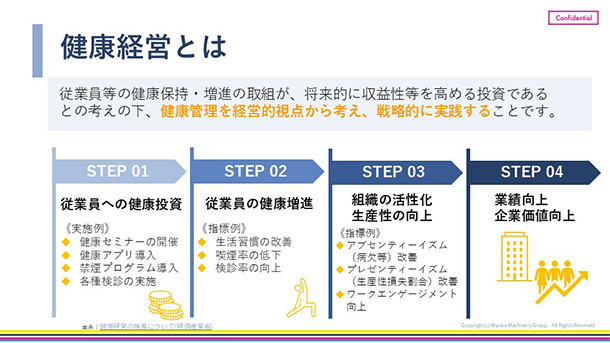
*Health Management: Strategically implementing employee health management from a business perspective
The Murata Machinery Group supports the mental and physical health of each and every employee, which is fundamental to their happiness. We will promote the creation of workplaces and the enhancement of systems to achieve this, aiming to ”realize a prosperous society” as defined in our Corporate Philosophy through the vibrant contributions and growth of all employees.
Daisuke Murata
President & C.E.O.
Murata Machinery, Ltd.

In order to achieve “the happiness of each and every employee” and “the realization of a prosperous society” as defined by our Corporate Philosophy, it is essential that our employees are healthy and thriving as they actively contribute and grow. We will strategically promote health management across the entire group, with the aim of "increasing the number of employees who are healthy in both body and mind and who work with enthusiasm."
We believe that improving individual lifestyle habits is essential for employees to thrive and grow. Therefore, we have identified five key areas—eating habits, exercise, sleep, smoking, and mental health—and are implementing various measures to address each of them. Moreover, we clearly outline on our Strategy Map how these initiatives transform employee health awareness and behavior, linking them to business issues.
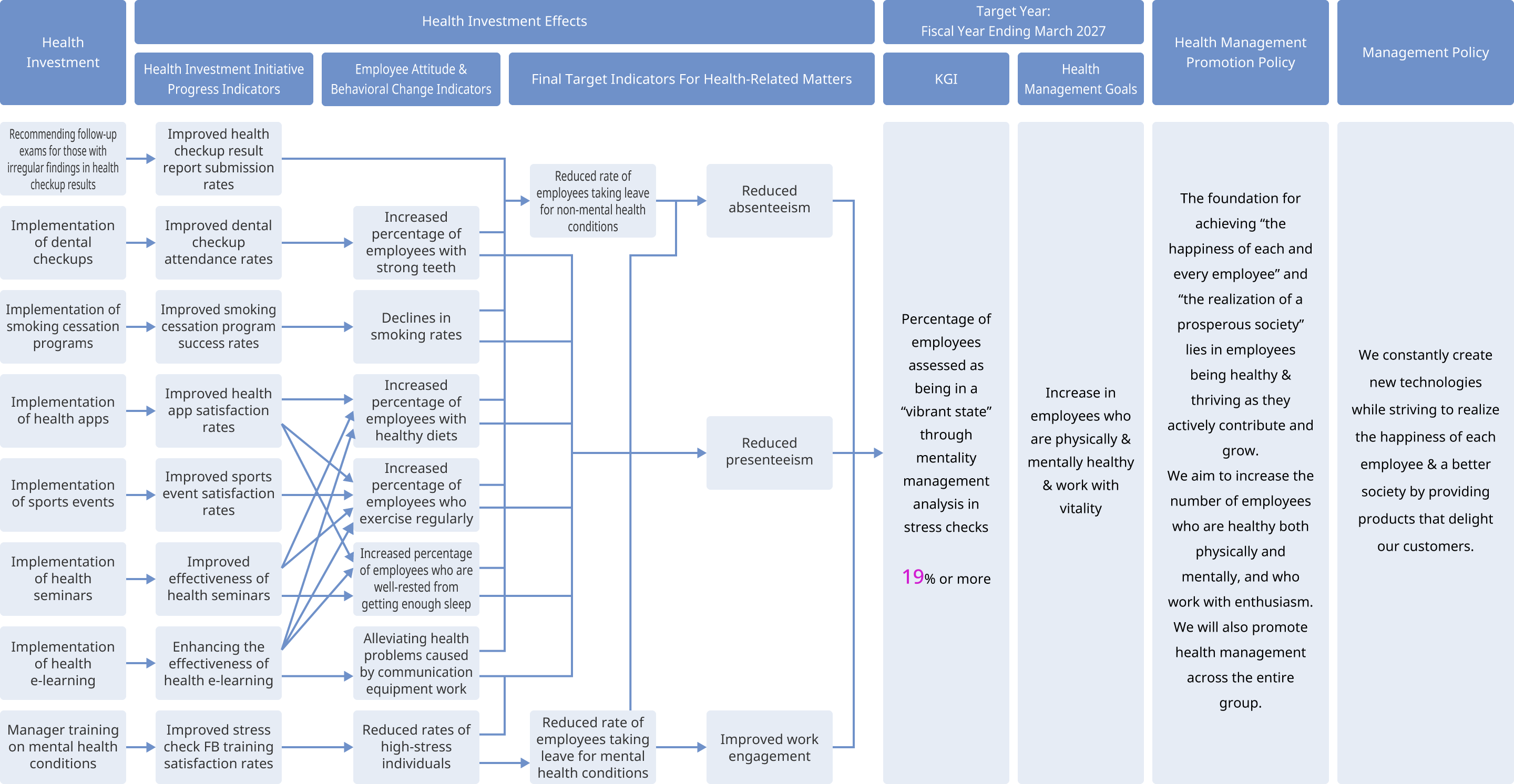
*Absenteeism: A state in which work cannot be performed due to physical or mental health issues, such as tardiness, early departure, or absences/leave that make it difficult to work
*Presenteeism: A state in which, despite being present at work, performance suffers due to physical or mental health issues
*Work Engagement: A positive and fulfilling psychological state toward one’s job

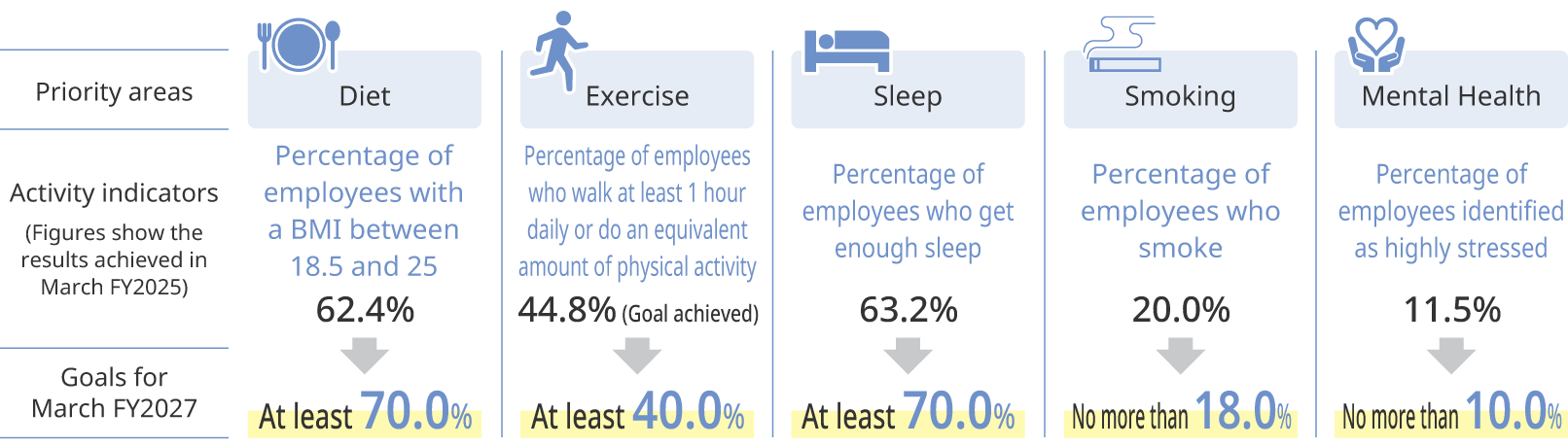
To address the management issues outlined in the Health Management Strategy Map, we have established KPIs for metrics related to employee health status and health management, along with the final target metrics. We are proceeding with various initiatives with the goal of improving all KPIs by the fiscal year ending March 2027. Regarding “Percentage of employees who are healthy, vibrant, and actively contributing to growth*,” which is one of our management issues, initiatives such as lifestyle improvements, enhanced communication, and mental health measures have led to a trend of annual improvement. The percentage was 67% in fiscal year 2023 and increased to 69% in fiscal year 2024.
| Area | Metrics | Achievement | Goal (up to 2027) | ||
|---|---|---|---|---|---|
| 2023 | 2024 | 2025 | |||
| Eating Habits | Percentage of employees with a BMI between 18.5 and 25 | 64.7% | 63.2% | 62.4% | 70.0% or more |
| Percentage of employees who skip breakfast 3 or more times a week | 22.9% | 22.5% | 23.8% | 15.0% or less | |
| Exercise | Percentage of employees who exercise 2 or more days a week | 22.3% | 22.8% | 25.0% | 25.0% or more |
| Percentage of employees who walk or engage in an equivalent physical activity for at least 1 hour daily | 38.3% | 38.4% | 44.8% | 40.0% or more | |
| Sleep | Percentage of employees who are well-rested from getting enough sleep | 64.6% | 63.6% | 63.2% | 70.0% or more |
| Smoking | Percentage of employees who smoke | 20.3% | 19.5% | 20.0% | 18.0% or less |
| Teeth | Percentage of employees who can chew and eat anything | 90.3% | 90.3% | 89.6% | 95.0% or more |
| Mental Health | Percentage of employees identified as high-stress individuals in stress checks | 12.1% | 12.0% | 11.5% | 10% or less |
| Working Hours | Average total actual working hours per person | 1950 hours | 1951 hours | 1959 hours | 1900 hours or less |
| Area | Metrics | Achievement | Goal (up to 2027) | ||
|---|---|---|---|---|---|
| 2023 | 2024 | 2025 | |||
| Health Checkups | Percentage of employees who underwent regular health checkups | 100.0% | 100.0% | 100.0% | 100.0% |
| Percentage of employees with health concerns who submitted a medical examination report | 89.0% | 90.8% | 91.6% | 92.0% or more | |
| Mental Health | Percentage of employees who underwent stress checks | 93.5% | 92.8% | 94.4% | 100.0% |
| Area | Metrics | Achievement | Goal (up to 2027) | ||
|---|---|---|---|---|---|
| 2023 | 2024 | 2025 | |||
| Absenteeism | Percentage of employees taking long-term absences/leave due to physical or mental illness*1 | 2.1% | 1.5% | 1.4% | 1.0% or less |
| No. of people surveyed | 6168 | 5739 | 5851 | ||
| Presenteeism | Percentage loss due to presenteeism based on SPQ (Tokyo University Single-Item Presenteeism Question)*2 | 23.6% | 23.6% | 23.5% | 20.0% or less |
| No. of people surveyed | 4948 | 5239 | 5491 | ||
| Response rate | 93.5% | 92.8% | 94.4% | ||
| Work Engagement | Work Engagement Deviation Score*3 | 49.2 | 49.6 | 49.8 | 51 or higher |
| Percentage of employees identified as high-engagement individuals in stress checks | 9.7% | 10.3% | 11.0% | 11.0% or more | |
| No. of people surveyed | 4948 | 5239 | 5491 | ||
| Response rate | 93.5% | 92.8% | 94.4% | ||
| Vitality Level | Percentage of employees assessed as being in a “vibrant state” through mentality management analysis in stress checks | 12.5% | 13.8% | 15.0% | 19.0% or more |
*1: Measures the percentage of employees who have been absent or on leave for one month or longer due to mental or non-mental health issues.
Measures the percentage of employees who were absent or on leave.
*2: Performance level (0–100%) measured using SPQ (Tokyo University Single-Item Presenteeism Question).
Actual values are calculated as the average loss ratio for all employees. The higher the value, the greater the loss.
Measured using the stress check contractor’s proprietary metrics. Actual values are calculated as deviation scores.
Higher values indicate greater work engagement.
We have implemented various measures to improve the key areas of eating habits, exercise, sleep, and smoking.
We have introduced the AI health app “Calomama Plus” to provide an opportunity for employees to reexamine their own eating, exercise, and sleep habits. Additionally, we are promoting usage by holding walking events and point campaigns for app users.
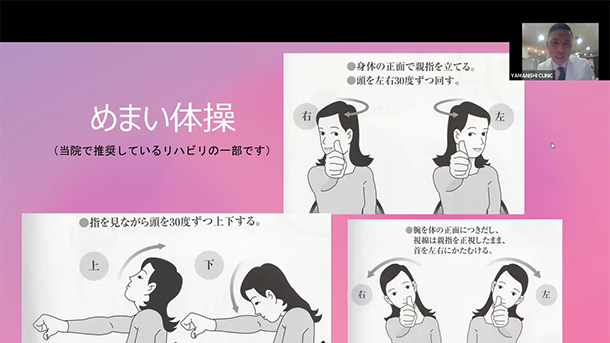
We host annual health seminars featuring external lecturers, tailored to meet employee needs. We offer sleep management programs, online training sessions led by RIZAP trainers, and seminars on cancer and blood pressure. Since fiscal year 2022, we have expanded participation eligibility to also include our supply chain partners.
We have introduced the “ascure™ Graduate from Smoking” program. We support smoking cessation through a comprehensive three-pronged approach of “online support from certified medical instructors,” “a dedicated support app developed by physicians,” and “provision of smoking cessation medication.” Since its introduction in 2021, approximately 60% of participants have successfully quit smoking.

We conduct annual e-learning programs covering health management initiatives, lifestyle improvement, and health issues specific to women. The participation rate for the fiscal year 2024 program was 92%. 95% of participants reported that their "awareness of health matters had improved," and 79% stated they were now "taking better care of their own health."
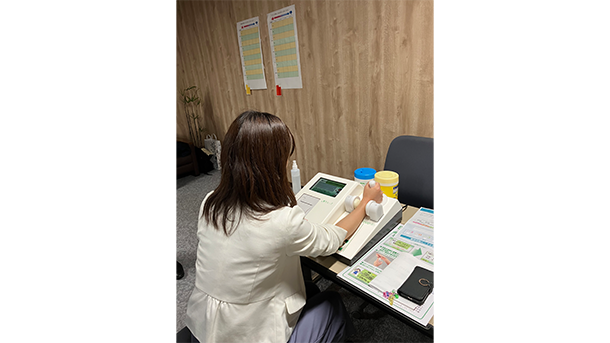
We regularly hold joint wellness fairs with our business partners to measure health indicators such as vascular age, bone density, and vegetable intake. Screening results are provided to employees along with an advice sheet, creating an opportunity for them to reconsider their lifestyle habits.
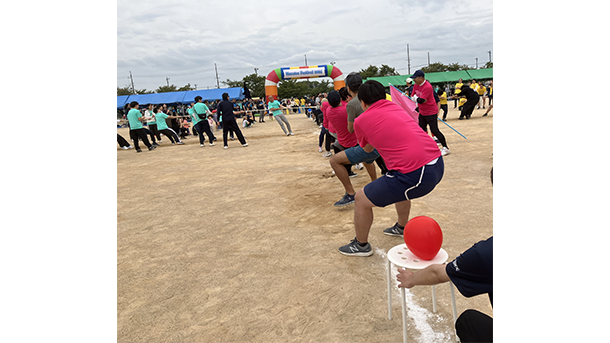
We hold various events with the expectation that they will stimulate communication among employees and contribute to their physical and mental well-being. Additionally, the company offers club activities and provides venues and support for these activities.
We hold an annual sports day event for employees and their families. We organize team-based competitions and provide activities in addition to the games, such as a physical fitness testing corner, game corner, and food stalls, to foster communication among employees and their families.
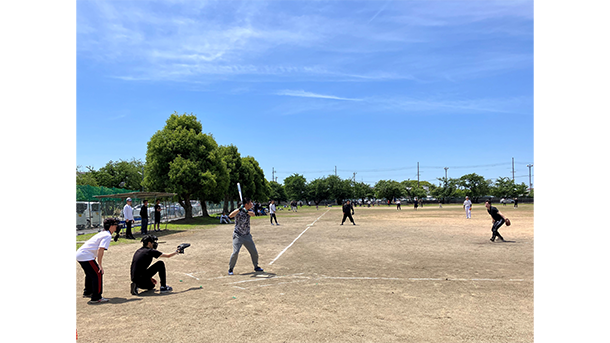
We hold a softball tournament every year. This tournament fosters teamwork among employees by having departments compete against each other.
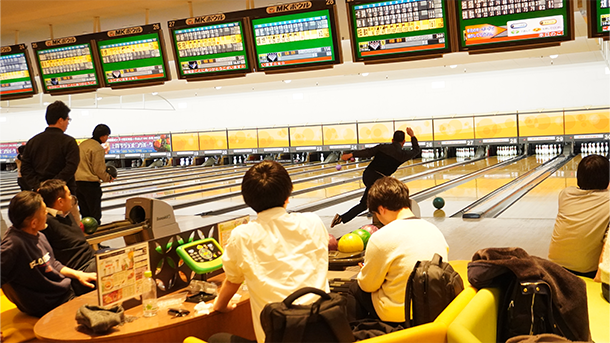
Every year, we host health events such as bowling tournaments, yoga classes, and walking events.
Every June, we conduct stress checks at all workplaces and sites, including small-scale sites with fewer than 50 employees.
Based on the results of the stress check, we conduct a collective analysis of workplace-specific stress patterns and causes. We then provide feedback to managers and request that they develop and implement action plans to improve the environment in the relevant workplaces. Additionally, as part of self-care initiatives, seminars were held for job levels where group analysis results indicated a high number of individuals experiencing high stress, and labor management briefings for managers were also conducted as part of our line care initiatives. The percentage of employees identified as “high-stress” in the stress check decreased from 12.0% in fiscal year 2023 to 11.5% in fiscal year 2024.
We ensure all employees undergo regular health checkups, maintaining a 100% participation rate domestically. Individuals with irregular findings in their health checkup results are advised to seek medical consultation, and occupational physicians & public health nurses follow up to confirm treatment status and send reminders those who have yet to submit their results. Starting in fiscal year 2016, the introduction of network health checkups has enabled us to standardize health checkup result criteria and promptly recommend follow-up examinations for individuals with irregular findings. In fiscal year 2020, we invested approximately 6 million yen to implement a new health management system. Since then, we have been investing approximately 3 million yen annually to centralize information management, streamline administrative tasks, and expand the scope of system coverage. Additionally, in fiscal year 2023, we implemented a system that enables employees to view their regular health checkup results online, creating an environment where employees can check their results anytime they need to.
For individuals eligible for specific health guidance, we provide such guidance through external contractors and our in-house public health nurses. We actively promote online specific health guidance to enable individuals to receive instruction regardless of their workplace or schedule, with an implementation rate of 14.3% in fiscal year 2023.
The Murata Machinery Health Insurance Association conducts annual dental examinations. Additionally, we collaborate with health insurance associations to provide assistance with comprehensive health checkups, mail-in cancer screenings, and tumor marker tests in order to prevent disease & enable early detection.
We offer systems to maintain work-life balance, including staggered work hours, shortened work hours, telework, and the ability to take paid leave in one-hour increments. Additionally, a “Work-Treatment Balance Support System” has been established to enable employees to continue receiving treatment while working, even if they have pre-existing conditions.
The Health Management Alliance, with a vision to “revitalize Japanese companies through employee health and achieve the sustainability of health insurance,” has approximately 480 member companies and organizations. Our company has been a member since December 2023. Through participation in seminars and other activities, we learn methods for promoting health management and best practices from other companies, applying these insights to solve our own issues.