

In recent years, transport systems have played an increasingly important role in production lines and logistics. However, quantitatively understanding how individual failures impact overall system performance is not straightforward.
Traditionally, layout design and control logic evaluations have often focused on normal operating conditions, and design metrics that consider the impact and recoverability during failures have not been sufficiently established.
To address this issue, a technology for evaluating the resilience of transport systems is required.
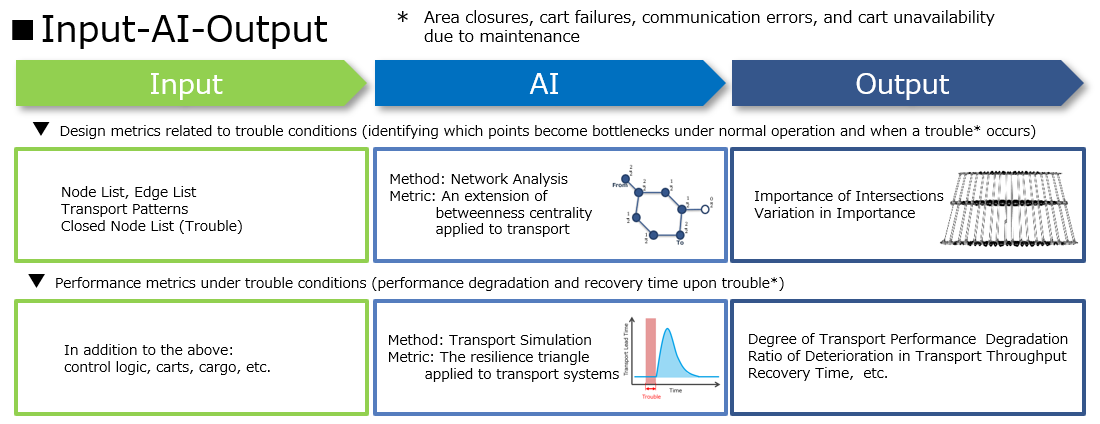
In this technology, the transport layout is represented as a network structure consisting of “intersections (nodes)” and “transport routes (edges).”
By overlaying actual transport patterns on this network, the system analyzes which intersections carry a high concentration of transport routes.
A resilience design metric is used to indicate the degree of route concentration, allowing evaluation of how much a system-wide impact would occur if a particular intersection were to stop functioning.
This enables visualization of locations likely to become bottlenecks both under normal conditions and during failures.
On the performance evaluation side, transport simulations are used to dynamically close specific nodes or routes, and the time-series change in transport performance is analyzed.
By calculating metrics such as the number of completed transports, the extent of throughput degradation, and the time required for system recovery, the impact of failures can be quantitatively assessed.
These results enable relative comparisons of different layout designs and control logic strategies.
This evaluation technology can be applied during layout design to identify potential bottlenecks and provide guidance for increasing system redundancy.
Resilience performance evaluation metrics also contribute to improving control logic and enhancing the overall resilience of transport systems.
Looking ahead, this approach is expected to be applied to design optimization in smart factories and complex transport networks.
It has the potential to become an effective method for building more reliable transport systems with higher robustness and recoverability.