

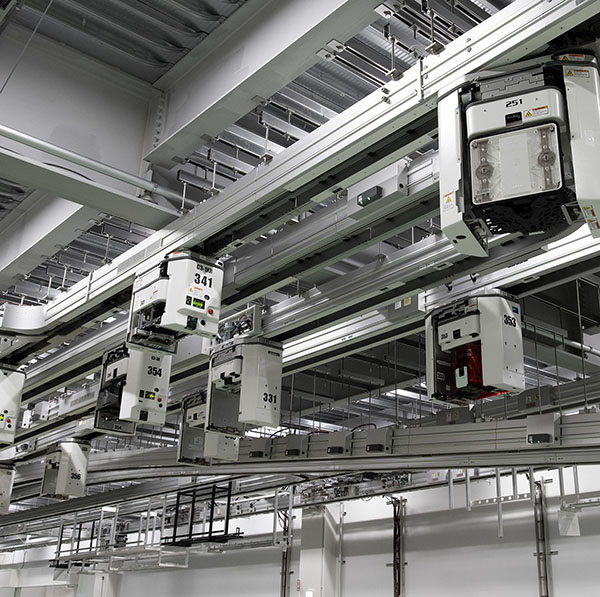
In transport systems where multiple vehicles operate simultaneously, the inability to anticipate future congestion or vehicle availability has often led to reduced efficiency and increased waiting times.
Conventional systems have relied heavily on real-time control, making it difficult to implement planned control strategies based on future predictions.
To address this challenge, technologies are now required that can forecast the future behavior of a fleet of vehicles and utilize this information for transport control and empty-vehicle management.
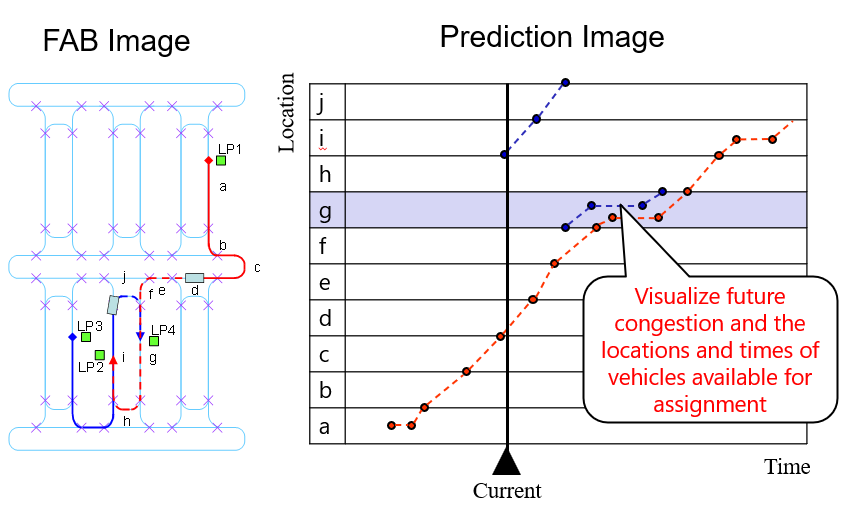
This technology predicts the expected arrival times at each segment by providing information about the routes that each vehicle will traverse, while accounting for potential interactions such as crossings or waiting with other vehicles on the same paths.
As a result, it becomes possible to visualize and understand the future behavior of multiple vehicles in a time‑series manner, even in environments where many vehicles move concurrently.
Using the predicted arrival times, the system can estimate future congestion levels and the distribution of available vehicles. This information is then applied to both transport control and empty-vehicle control.
Furthermore, by estimating future bottlenecks and identifying when and where vehicles will be available for task assignment, the system enables reservation‑based job allocation.
These predictive capabilities help maintain efficient transport even in environments where the number of vehicles is limited.
This technology enhances the planning capabilities of transport systems, contributing to higher vehicle utilization and reduced waiting times.
In the future, when combined with AI‑driven optimization techniques, it is expected to enable more advanced transport planning and energy‑efficient operations in smart factories and large‑scale logistics systems.
In particular, transport control utilizing reservation functions is anticipated to become an effective method for maintaining high transport performance with limited vehicle resources.